 Waymark Nordic
Walking with poles looks simple until you browse an equipment catalog. You find single shafts of fixed carbon alongside two-piece and three-piece telescoping designs with external cams or internal expanders. Both styles plant into dirt, pavement, and gravel, yet they behave differently the second you drive your weight through the wrist straps. Choosing between a fixed-length pole and an adjustable model affects how your arms absorb impact, how easily you pack for transit, and how much energy you expend over a two-hour workout.
The core distinction comes down to continuity. A fixed pole is a single, uninterrupted tube designed to match your body measurements precisely. An adjustable pole splits that tube into overlapping segments secured by hardware. That mechanical seam gives you versatility across slopes and luggage compartments, but it also alters the swing weight and how vibration travels up into your elbows. Here is how both systems compare when put to work on actual trails.
Structural Rigidity and Vibration
Every time a pole tip strikes asphalt or packed dirt, an impact wave travels up the shaft toward your hand. In a fixed-length pole, this energy moves through a uniform wall thickness without interruption. High-grade composite tubes dampen this vibration before it reaches the grip, dispersing the frequency along the entire length of the shaft. The result is a crisp, solid plant that returns your pushing energy directly into forward propulsion rather than flex.
Adjustable poles introduce joints where smaller tubes slide inside larger ones. These overlap zones create distinct stiffness points. An adjustable shaft is doubly thick where the sections overlap, but the mechanical locking point can act as a bridge for high-frequency vibration. In poorly fitted or worn adjustable poles, you may feel a faint rattle or a buzzing sensation in your palm at the moment of ground contact. Over ten thousand strides, that minor oscillation can fatigue the tendons in your wrists and forearms.
Rigidity also determines how much the pole bows under load. Nordic walking relies on an aggressive backward push through the strap at roughly a forty-five-degree angle. If a shaft flexes excessively under that diagonal force, you lose forward drive. One-piece shafts maintain predictable lateral deflection across their entire span, which provides a reliable plant whether you are walking an easy neighborhood loop or pushing hard up a fire road.
| Pole Characteristic | Fixed-Length Shaft | Adjustable Shaft (Two-Piece) |
|---|---|---|
| Vibration Absorption | High, consistent along tube | Moderate, interrupted by joints |
| Shaft Rattle Risk | None | Low to moderate as hardware ages |
| Lateral Deflection | Predictable and minimal | Variable across segment junctions |
| Energy Transfer | Direct push through strap | Slight loss through hardware flex |
Weight Differences in Shaft Materials
Weight on a walking pole matters most at the bottom of the tube. This is known as swing weight, the effort required by your fingers and wrist to bring the pole forward after completing your backward push. A pole may have a low overall weight on a kitchen scale, but if the lower third is heavy, your arms work harder on every single recovery stroke.
Fixed poles carry an immediate advantage in swing dynamics because they lack adjustment collars, internal plastic wedges, and steel bolts. A dedicated fixed carbon pole often weighs between 140 and 175 grams per pole, depending on the carbon percentage and strap assembly. Because the bottom tapers smoothly down to the tip without metal hardware, the tip snaps forward naturally with minimal hand intervention as you open your palm at the end of the push.
Adjustable poles must add material to function safely. A typical two-piece pole weighs between 195 and 240 grams, while three-piece travel poles often exceed 260 grams. That extra mass comes from the hardware placed midway down the pole, exactly where it increases pendulum inertia. Aluminum adjustable poles are especially prone to this heavy swing feel, though they offer exceptional resistance against rock strikes that might fracture brittle lightweight composites.
- Pure Carbon (70 to 100 percent): Lightest swing weight, superior vibration damping, brittle against sharp lateral impacts. Standard on premium fixed poles.
- Carbon Composite (30 to 60 percent): Balanced feel, moderate flex, more affordable, common in mid-tier fixed and upper-tier adjustable shafts.
- Aircraft Aluminum (7075 series): Highly durable, bends instead of snapping under stress, heavier swing weight, typical material for adjustable lower shafts.
Twist Locks Versus Lever Clamps
If you choose an adjustable model, the locking mechanism dictates how reliable your pole will be on the trail. Manufacturers rely on two main systems: internal twist expanders and external lever clamps. Both have specific strengths and maintenance demands.
Internal twist locks use an expander plug threaded onto a central screw inside the shaft. When you rotate the lower section clockwise, the expander spreads against the inside wall of the upper tube, locking it in place with friction. This design keeps the exterior shaft smooth and streamlined, eliminating catches on brush or clothing. However, moisture, trail grit, and cold temperatures can cause internal expanders to slip. If fine sand enters the joint, the plastic expander can spin freely without gripping, leaving your pole collapsed when you apply downward force.
External lever clamps, often called flip locks, wrap a collar around the outer tube and squeeze it shut using an exterior cam lever. You can visually confirm whether the lever is closed, and you can adjust the clamping tension using an external thumbscrew without disassembling the pole. These mechanisms operate reliably in rain, mud, and freezing weather, even when you are wearing thick winter gloves. The trade-off is exterior bulk, added weight, and the occasional snag on tall grass or loose gear straps.
| Feature | Internal Twist Lock | External Lever Clamp |
|---|---|---|
| Profile | Smooth, streamlined exterior | Protruding lever and hinge hardware |
| Ease of Adjustment | Requires wrist torque; hard with wet hands | Simple flip motion; easy with gloves |
| Field Maintenance | Requires disassembling to clean internal plug | Tightened with a coin or thumb screw |
| Reliability in Dirt | Susceptible to slippage from fine silt | Resistant to dirt; easy to wipe clean |
Sizing Rules for One-Piece Shafts
Buying a fixed pole requires getting your measurements right before you take the tags off, because you cannot shorten or lengthen the tube once you hit the trail. The classic sizing formula is straightforward: multiply your total height in centimeters by 0.68. For example, a walker who is 175 centimeters tall calculates a pole height of 119 centimeters, which rounds to a standard 120-centimeter fixed pole.
That formula provides a useful baseline, but body proportions and personal mechanics often require minor adjustments. If you have long forearms or wear thick-soled trail shoes, you might need the next size up. If you are rehabbing a shoulder issue or prefer a gentler tempo, rounding down keeps your elbow angle slightly below ninety degrees, reducing strain on your rotator cuff. If you have flexibility & mobility, consult a physical therapist before choosing a pole height, as an incorrect angle can irritate your neck and shoulders.
To verify the fit of a one-piece pole in person, put on your typical walking shoes and stand on a flat surface with your shoulders relaxed:
- Slip your hands into the ergonomic straps and grip the handles lightly, resting the pole tips flat on the floor beside your feet.
- Check the angle inside your elbow joint. Your forearm should sit parallel to the floor or angled slightly downward, creating an interior elbow angle between 90 and 95 degrees.
- Ensure your shoulders remain level. If your shoulder bunches upward toward your ear to hold the grip, the pole is too tall.
- Lean your torso forward slightly into the walking stance. Your elbow should not have to reach backward excessively to plant the tip behind your hip.
Making Your Final Decision
The choice between fixed and adjustable poles comes down to where you walk and how you travel. Neither system is universally superior; each solves a different set of logistical and biomechanical requirements.
Choose fixed-length poles if your walks happen primarily on local trails, paved pathways, or neighborhood loops where you leave directly from your front door or car trunk. Fixed poles are also the better choice if you walk for athletic conditioning, where high cadence and pure power transfer matter. The absence of moving parts eliminates joint wear, prevents slippage during powerful pushes, and delivers the lightest swing weight available. They are reliable tools: you clip into the straps and start walking without checking screws or measuring lines.
Choose adjustable poles if you travel frequently by plane, share your gear with a partner, or navigate mixed mountain terrain. Telescoping poles collapse down to fit inside checked luggage or secure against a daypack. If you tackle steep mountain ascents followed by long descents, an adjustable pole allows you to shorten the shafts by five centimeters for the climb and lengthen them for the descent. That flexibility is invaluable on changing grades, even if you accept a few extra grams and slightly more shaft vibration.
Common Mistakes
Walkers often run into preventable frustrations when selecting their poles. These errors lead to premature gear failure or discomfort along the trail.
Relying on trekking pole straps for Nordic technique: Many newcomers buy adjustable trekking poles thinking they are identical to Nordic walking poles. Trekking poles have loose webbing loops meant for downhill bracing. Nordic walking requires an ergonomic, glove-like strap that wraps the thumb and palm, enabling you to release and catch the grip on every single stride.
Over-tightening internal twist locks: When an internal expander slips, the natural reaction is to twist the shaft with extreme force. Doing so strips the internal plastic threads or splits the aluminum housing. If a twist lock slips, disassemble the segments, clean out the dust with a dry cloth, and reassemble it without oil.
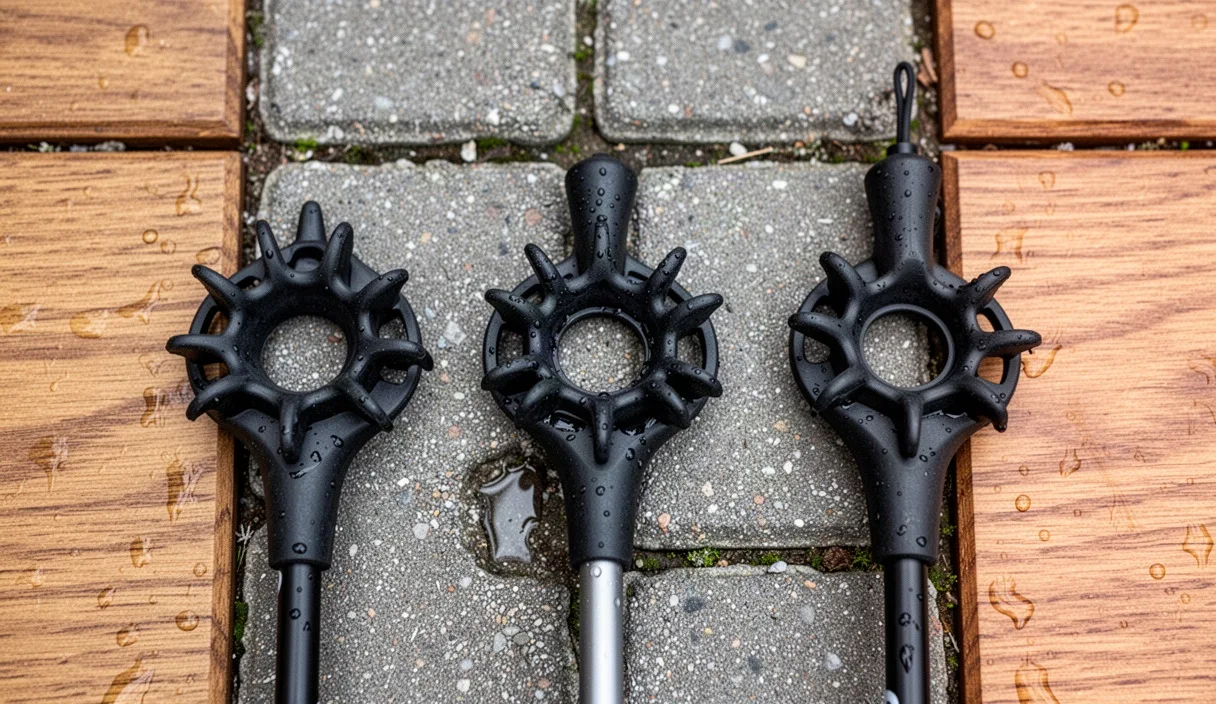
Ignoring the rubber paw angle on fixed poles: Rubber asphalt pads are shaped like small boots with an angled base. On fixed poles, the pad must align precisely with the backward angle of your push. If the paw spins out of alignment, the grip on wet asphalt decreases and the rubber wears down unevenly.
Leaving damp adjustable poles collapsed: Storing wet telescoping poles inside a closet traps moisture inside the tubes. Aluminum poles can develop white oxidation powder that seizes the joints, while carbon poles can grow mildew on internal plugs. Always pull adjustable poles apart to dry after walking in the rain.
Next Steps for Walkers
Before purchasing your next set of poles, spend time assessing your walking routine. If your walks happen on predictable ground within driving distance of home, borrow a pair of fixed poles from a local club or specialty shop to feel the difference in swing weight. That crisp, featherweight response is hard to match once you have experienced it over a long workout.
If you decide on adjustable poles, inspect the locking mechanisms every few weeks. Check that external cam levers close with firm thumb pressure without bowing the plastic, and keep the lower sections wiped clean of fine grit. By matching your equipment to your terrain and maintaining the hardware properly, your poles will support healthy posture, fluid movement, and thousands of miles of steady forward momentum.