

Waymark Nordic
+44 1273 911508

Daily movement studio

United Kingdom

Daily mobility routines you can do at home

A small set of short sequences for stiff mornings, long desk days and quiet evenings. No equipment, nothing longer than fifteen minutes, and every one has a seated version.

Open the routine index

Start where you are, stay close to what feels easy

How this page works

Pick one routine and repeat it for a week

This page is the practical core of Waymark Nordic: a handful of short sequences built for people who want to restore joint mobility without turning a morning into a training session. Each one moves ankles, knees, hips and back through a comfortable range, in an order that echoes the pushing-and-turning pattern of walking.

You do not need to run all of them, and you do not need to run any of them perfectly. Choose one, keep it for seven days, then adjust the length, the tempo or the position. Consistency across an ordinary week does more for daily movement than a single ambitious session.

A woman seated on the edge of a bed, slowly circling one ankle as part of a short morning movement sequence

Seated ankle circles, the first minute of the morning sequence

Four routines, in order of how many minutes you have

Ten minutes · morning

The 10-minute morning routine

This is the one most people should try first. Start seated on the edge of the bed and roll each ankle ten times, then begin knee bends through a comfortable range until the movement stops feeling new. Stand, hold the kitchen counter and swing each leg forward and back, then side to side, letting the leg do the travelling rather than the hips. Finish with a slow hip circle in each direction and a gentle lower-back rotation. Ten minutes covers ankles, knees, hips and back in the order they are used when you walk.
Three minutes · very stiff mornings

A 3-minute version for the mornings that nothing is happening

Some mornings, ten minutes is simply not available. Use this instead. Seated ankle circles in each direction. Seated knee extensions, one leg at a time, pausing at the top. Two slow shoulder rolls. That is the whole thing, and it still counts. The purpose of a bad-morning routine is not to make progress; it is to keep the habit alive so tomorrow's longer version is still an option. A short session on a difficult day keeps the week intact.

If a morning allows only this, that is a legitimate session. Speed is not the goal; keeping the pattern unbroken is.

Four one-minute pieces · workday

The desk-break routine

Two hours in a chair leaves hips and knees quietly stiff, and the stiffness tends to be noticed only when you finally stand up. This routine is deliberately broken into four one-minute pieces you can slot between tasks: a standing hip flexor stretch with a hand on the wall, seated knee extensions, standing calf raises holding the edge of the desk, and a slow neck-and-shoulder roll. None of them require leaving the room, and none of them need a mat.

If your workplace allows standing phone calls, that alone interrupts the pattern without adding anything to your to-do list.

Slow holds · evening

The evening wind-down sequence

Mornings get the attention, but some people find themselves stiffest at night. This sequence uses the same principles at a slower tempo: longer holds, breathing kept easy, and no pushing into range. Range-of-motion work through the hips and ankles first, then a supported calf stretch at the bottom of the stairs with both hands on the banister or the wall. Hold positions where comfortable for around thirty seconds and up to two minutes, following the pattern described in physiotherapy self-help material from Newcastle Hospitals NHS Foundation Trust. It is a wind-down, not a workout.

Range of motion, and why we start there

Movement comes before load in every routine on this site. You move an area through a comfortable range, then ease a little further into warmth. That last phrase matters: easing, not forcing.

If something simply will not travel as far today as it did yesterday, that is information rather than failure. Do what is available, note it, and come back tomorrow. A small comfortable improvement across a week is the pattern working exactly as expected.

Sensation guide

Mild and steady

A warm pull that eases when you back off slightly is the usual sign the position is doing its job. Stay there, breathe slowly, and count rather than guess.

Sensation guide

Sharp or rising

If a position produces a sharp sensation, or one that increases while you hold it, that is your signal to come out of the movement and let it settle before continuing.

How to hold a stretch without overdoing it: hold, breathe, and do not bounce. Thirty seconds is the usual entry point for a gentle stretch, and up to two minutes suits some positions, particularly calves and hip flexors. The temptation is to chase the end range and settle there. Stay where the sensation is mild and steady, count slowly, and come out just as deliberately as you went in. If you cannot breathe easily in a position, you have gone further in than you need to be.

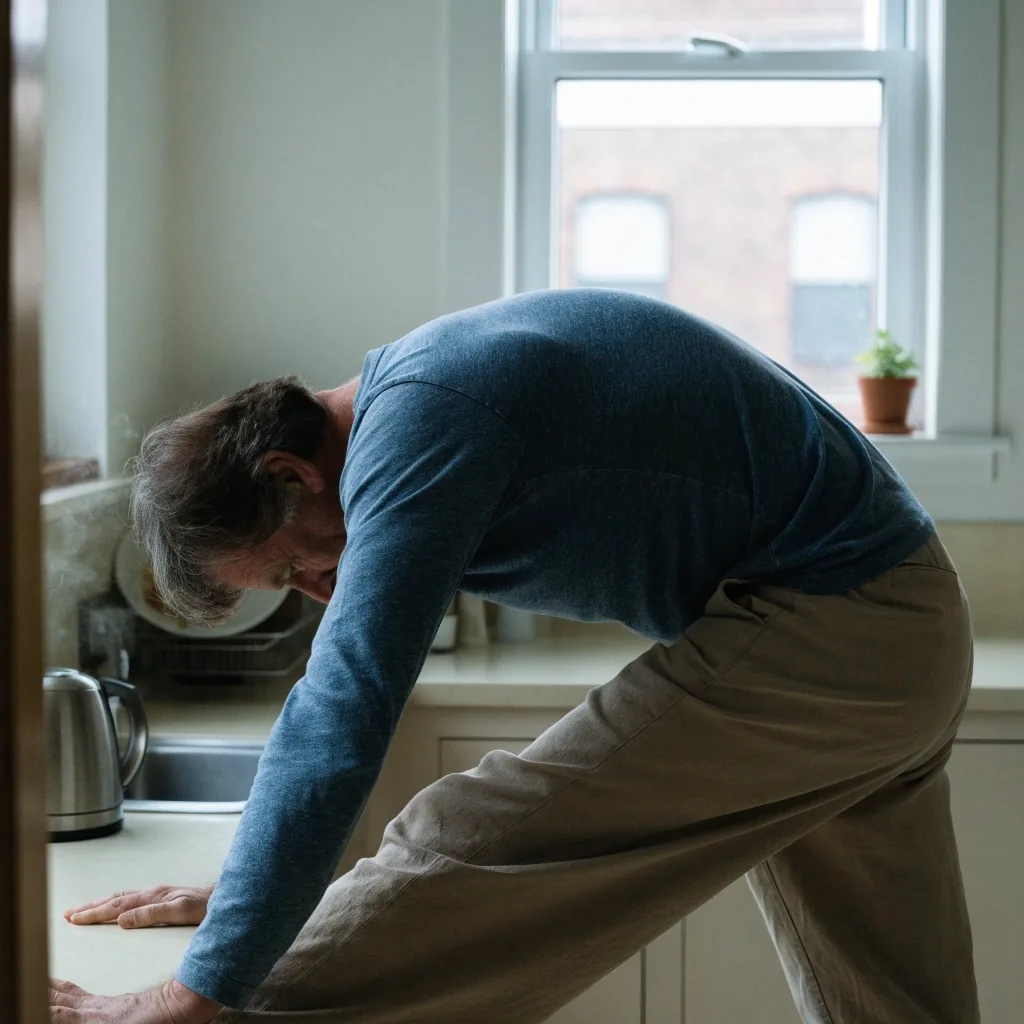
A man steadying himself on a kitchen counter as he eases into a supported calf stretch

A supported calf stretch at the kitchen counter, held without pushing into range

Building a week around two strength sessions

Every day

Short daily mobility

One of the four routines above, done at whatever length the day allows. This is the thread that holds the week together, and the only part that needs to be non-negotiable. Supporting joints daily through a comfortable range keeps the hours in a chair from quietly setting the tone for everything else.

Anchor habit, not intensity

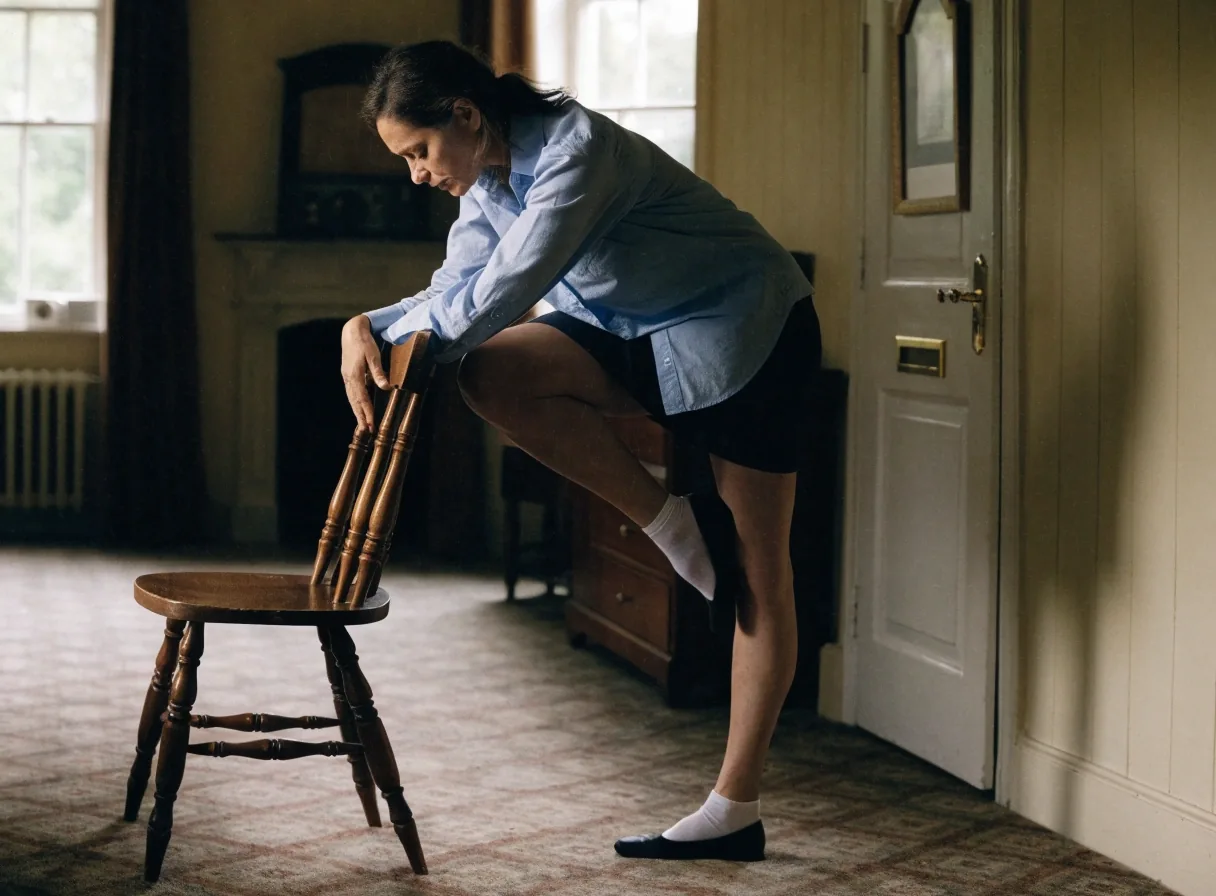
A woman steadying herself on the back of a chair as she lifts one knee during a supported strength movement

Two or three times a week

Simple lower-body work

Leg lifts and step work at home are enough. A kitchen chair and the bottom two stairs cover most of it, and you do not need a gym.

Two to five times

Walking or cycling

East Sussex Healthcare NHS Trust's lower-body exercise leaflet suggests stretching daily, strengthening two or three times a week, and aerobic work two to five times a week. Walking fills that last slot without any planning at all, and a flat shared path is as good as a gym.

That shape of week is realistic: short daily mobility, two or three slots for strengthening, and walking or cycling covering the rest.

Read pacing guidance for flare-up days

Adapting on a difficult day, and when to move the routine

Adapting the routine on a flare-up day

Scale back rather than skip. Cut the range, halve the time, and stay seated if getting down to the floor is uncomfortable. NHS Inform's guidance is straightforward: stop exercises that make things feel worse or cause new discomfort, and give it time.

A difficult-day session might be six minutes of seated movement, and that is a legitimate session. Skipping entirely makes the next one harder, both physically and mentally, because the habit loses its rhythm and the starting line moves further away. A slower version of the routine keeps you inside the practice rather than outside it.

When to move the routine somewhere else

Home routines have limits. If lying on the floor is impractical, do everything seated or standing against a wall. If your stairs are steep, use the bottom two steps rather than the whole flight. If the routine stops fitting your space, that is usually a sign to change the routine rather than to give up on movement.

Everything on this page has a seated or supported variation, and switching between them week to week is fine. The routines are a starting shape, not a fixed set of rules, and the version that fits your kitchen, your stairs and your week is the version that will actually get done.

Where this guidance comes from

The sequence of movements on this page follows self-help material published for physiotherapy patients by Newcastle Hospitals NHS Foundation Trust, and the shape of the week is taken from East Sussex Healthcare NHS Trust's lower-body exercise leaflet. The cues on sitting, stopping and scaling back follow NHS Inform. These are public patient-education sources rather than a plan written for you, so use them as a starting point and adjust to what your own body reports.

Before you start

If you have an ongoing health condition, are recovering from an injury, or are unsure whether a movement is suitable, speak to a qualified health professional first. These routines are general information for keeping joints moving comfortably, not individual advice.

Questions people ask before they start

Do I need to do all the routines?

No. Choose one and repeat it. The 10-minute morning routine suits most people, and the seated options cover the days when standing first thing is uncomfortable. Picking a single routine and giving it a fortnight is a better experiment than running all four badly.

What if a movement feels uncomfortable rather than painful?

Mild, steady sensation that eases when you back off is usually fine. Sharp discomfort, or sensation that increases during the movement, is your signal to stop and give it time. Come out of the position slowly rather than quickly, and check whether a smaller version of the same movement feels easier tomorrow.

Can I do these routines in the evening instead?

Yes. The sequences work at any time of day. Some people prefer the evening wind-down version because the holds are longer and the tempo is slower, and a slow sequence can fit naturally between dinner and bed without needing a shower afterwards.

How long before I notice anything?

Most people find the first few steps of the day feel less locked within a week or two of daily practice. That is a general pattern rather than a promise, and it varies by person, by season and by how much the rest of the day involves sitting. Keep a short note of which routine you used and how the first steps felt.

Does it matter what time of day I do the desk-break routine?

Roughly every hour or two works better than once at lunchtime. Shorter breaks spread across the day keep the range you already have, which is easier than trying to win it back at the end of an afternoon. Setting a quiet reminder is enough; there is no need to turn it into a formal schedule.

Where to continue

One routine, one week, then decide

Start with the ten-minute morning sequence, or the three-minute version if the week is already full. Either way, the point is to keep something running so the pattern holds through the days when nothing is convenient.

If you would like more context before you begin, the pacing guidance covers difficult weeks, and the everyday habits page looks at how small movements during ordinary days add up alongside the routines on this page.

Helpful next steps

Reach us

48 Fenchurch Street, London EC3M 3LY, United Kingdom
Monday to Friday, 9:00 AM – 6:00 PM

Waymark Nordic — daily movement guidance