
Waymark Nordic
Everyday Movement Habits
Build movement into ordinary days
Some weeks the win is simply moving more often, in small ways, without changing your clothes or clearing a slot in the diary. This page is about the unglamorous habits that support joints daily.
Frequency, not duration
Why frequency beats duration
Comfortable joints tend to be joints that get moved often. Ten short movement breaks across a day do a different job from one 20-minute session, and for stiffness specifically, the frequent version often helps more. It also fits around work, childcare and the weather far more easily than a block of scheduled exercise.
Think of the aim as avoiding long static periods rather than accumulating exercise minutes. A day that never leaves you sitting for two hours straight is doing more for easy motion than a single hard session followed by an evening on the sofa. That reframing is what makes this page different from a workout plan: there is no set, no reps, and no kit — just a habit of interrupting stillness before it settles in.
What changes
-
Short breaks spread through the day rather than saved up for one slot.
-
No change of clothes and no equipment — the day supplies the surface.
-
Consistency of timing matters more than consistency of effort.
-
The plan survives busy weeks because it was never ambitious to begin with.
The chain of habits
Breaking up the long sit
Two hours in a chair is enough
You do not need a standing desk to break it. Stand during phone calls. Use the furthest kitchen, or the upstairs bathroom. Take the stairs once rather than committing to them all day. Set a reminder for every 45 minutes if you need one, and make the break 60 seconds rather than a full routine.
Short and unbothered is the point. A minute of standing and shifting weight is enough to interrupt the stillness that leaves hips and knees feeling set in place.
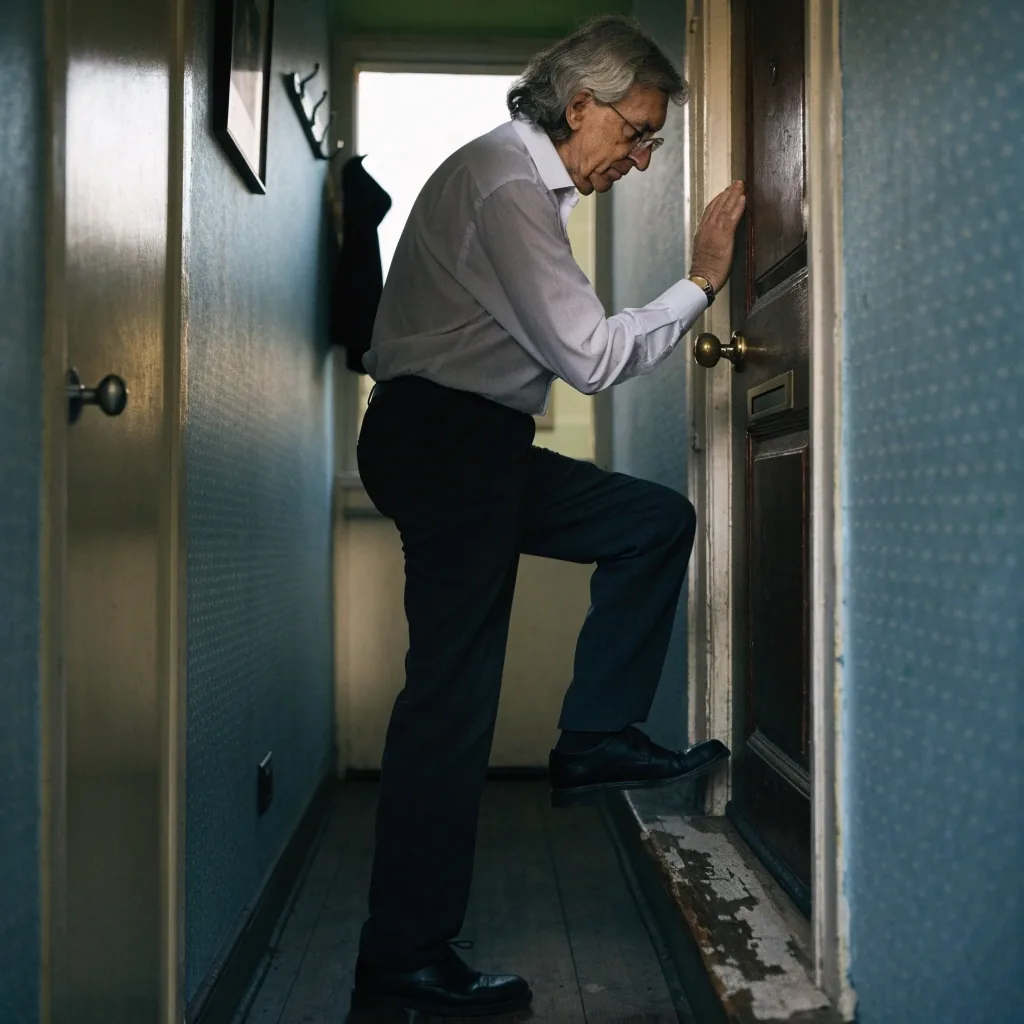
The front door step: stairs train the same pattern as step work
Standing call
One phone call, taken on your feet, is a break with no extra time spent.
Longer route
Walk to the furthest kettle or bathroom rather than the nearest one.
One flight
Take the stairs once. Committing to them all day is how habits break.
The minute
Sixty seconds standing and shifting weight, then back to the desk.
The ground under your feet
Stairs, kerbs, kerbstones
The ground you actually walk on
Everyday surfaces are a free balance and strength session. Stairs train the same pattern as step work. Kerbs and uneven pavement train steadier feet. None of it needs a gym, and all of it is already on the route you walk.
Stairs
Stairs train the step pattern
One flight a day at normal pace is a strength habit wearing everyday clothes. If a handrail helps, use it — that is not cheating, it is how you keep going.
Kerbs
Kerbs train steadier feet
Stepping up and down a kerb slowly, deliberately, is balance practice disguised as going to the shop.
Support
Use a handrail or a pole
If confidence on uneven ground is the issue, take the support and don't treat it as a setback. Confidence comes from doing the thing with support, then reducing the support — not from avoiding the thing until you feel ready.
Loads and the floor
Carrying, lifting, getting up
Real life involves loads
Shopping bags, grandchildren, a bag of compost. Knees and hips handle it better when the load is balanced across two hands and the movement starts from the legs rather than the back. Split a heavy bag into two lighter ones where you can — your body reads one balanced load more kindly than one lop-sided one.
For getting up off the floor, roll onto your side, push up to hands and knees, then bring one foot forward and stand using a stable chair or sofa if you need it. The trick is to practise it when you don't need to, so the pattern is familiar on the day you do.
Getting up, in order
-
1
Roll onto your side rather than sitting straight up.
-
2
Push up to hands and knees, keeping the movement slow.
-
3
Bring one foot forward and stand, holding a stable chair or sofa if you need it.
-
4
Practise it on a normal day, not the day you have to do it.
Through the darker months
Habits that survive a British winter
Lower the bar, not the habit
Cold, dark and wet is a genuine barrier in a British winter, not an excuse. The workaround is to lower the bar rather than abandon the habit: an indoor routine at home, a lap of the shopping centre, the stairs at home, or a shorter walk at the brightest part of the day.
People who keep the same time slot through the darker months tend to find it easier to pick the pace back up in spring. Consistency of timing holds the habit; consistency of effort is not required. And a lamp, a warm layer and a route you know by daylight will carry you through most of it.
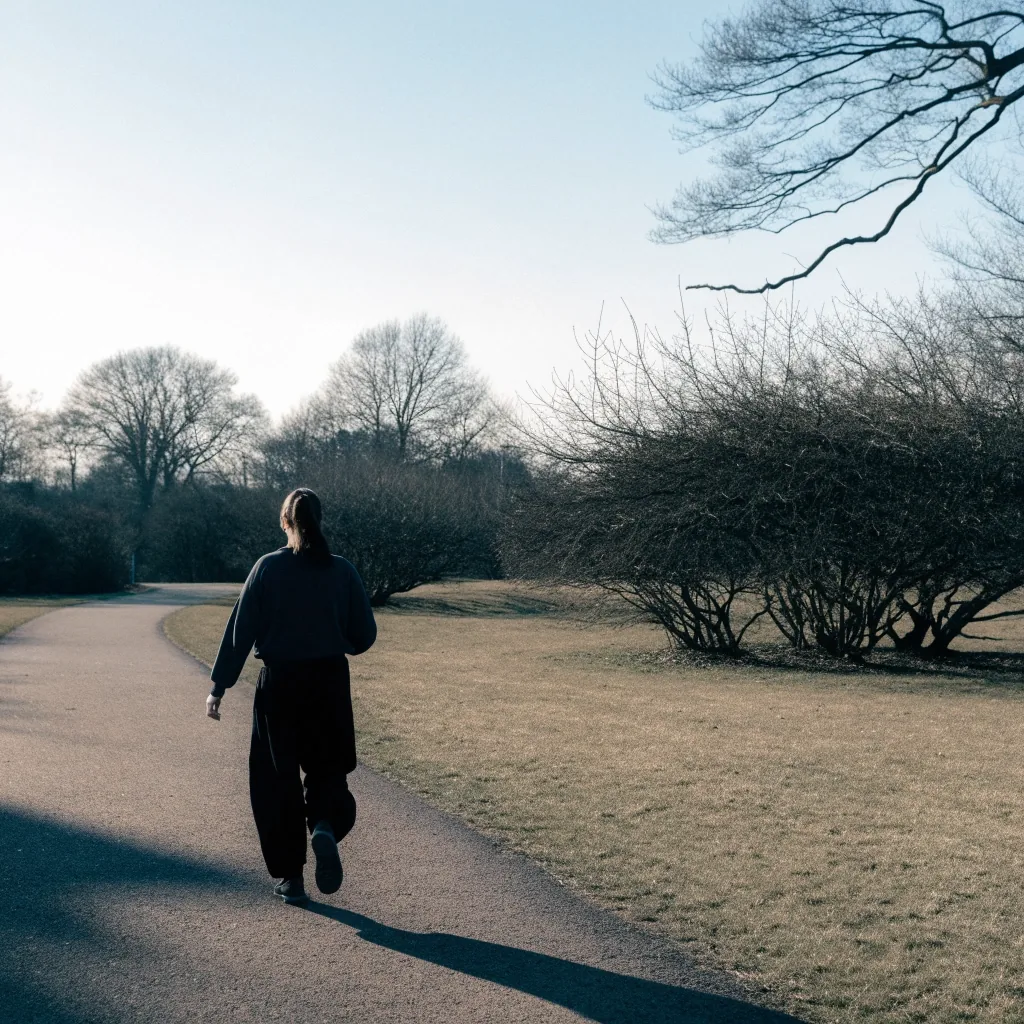
The brightest hour: a shorter walk, kept at the same time
Indoor option
The routine you already know, done at home on the wet days.
Weatherproof lap
A circuit of the shopping centre counts, and it is dry underfoot.
Keep the slot
Same time, lower effort — the habit outlasts the weather.
Pairing movement with what you already do
Habit stacking
Attach movement to something you already do
Pairing works because it removes the decision. Two or three of these pairings cover most of the day's stiffness risk without adding a single item to your list. Choose the ones that already happen at the times you tend to stiffen up.
While the kettle boils
Ankle circles
Stand on one foot and circle the other ankle, then swap. The kettle takes about as long as it takes to notice your ankles are stiff at all.
While brushing teeth
Calf raises
Rise onto the balls of your feet and lower slowly. Two minutes of brushing covers the whole job.
While the microwave runs
Hip stretch
Step one foot back and ease the hips forward, switching sides halfway.
When there is genuinely no time
Decide your minimum now
If your day is genuinely full, drop to the minimum: stand up and move for one minute, three times a day. That is it. It won't build strength, and it will keep the habit alive.
People who keep a minimum version through busy periods return to their full routine much faster than people who stop entirely and have to start again. Decide your minimum now, not on the day you need it. Write it on the fridge if that helps.
The minimum
One minute, three times
Stand, shift your weight, reach overhead, sit back down. That is the whole floor of the habit — low enough to keep on the worst week.
Common questions
Questions that come up often
How many movement breaks does a day need?
There is no fixed number. The point is to avoid sitting still for two hours at a stretch. For most people, five to ten short breaks spread across the waking day is enough to keep the habit and to keep easy motion through the afternoon.
Do short breaks replace a longer session?
They do a different job. A longer session can work on strength and range; short breaks keep you moving through the day and stop stiffness settling in. Many people keep both and treat the breaks as the layer that holds the week together when the longer session slips.
What if a movement break feels uncomfortable?
Reduce the range, slow the movement, or shorten the break to a stand and a shift of weight. If something continues to feel wrong rather than simply stiff, stop and speak to a health professional. This page is general information and not a substitute for individual advice.
How long before a new habit feels automatic?
It varies. Pairing the movement with something you already do — the kettle, the stairs, the walk to the shop — makes it stick faster than relying on memory or motivation, because the cue is already part of the day.
Where to go next
Keep the chain going
Habits carry you through the week; routines give the movement somewhere to go. If you want more structure to build on, the pages below are the next links in the chain.
Waymark Nordic publishes general movement information for adults in the United Kingdom. It is not a substitute for advice from a health professional, and nothing here promises a particular outcome. If a movement causes sharp or lasting discomfort, stop and seek qualified advice.
48 Fenchurch Street, London EC3M 3LY, United Kingdom
Monday to Friday, 9:00 AM – 6:00 PM
+44 1273 911508 [email protected]The rule continues